MgA.
Stanislav ZÁBRODSKÝ
2022
-
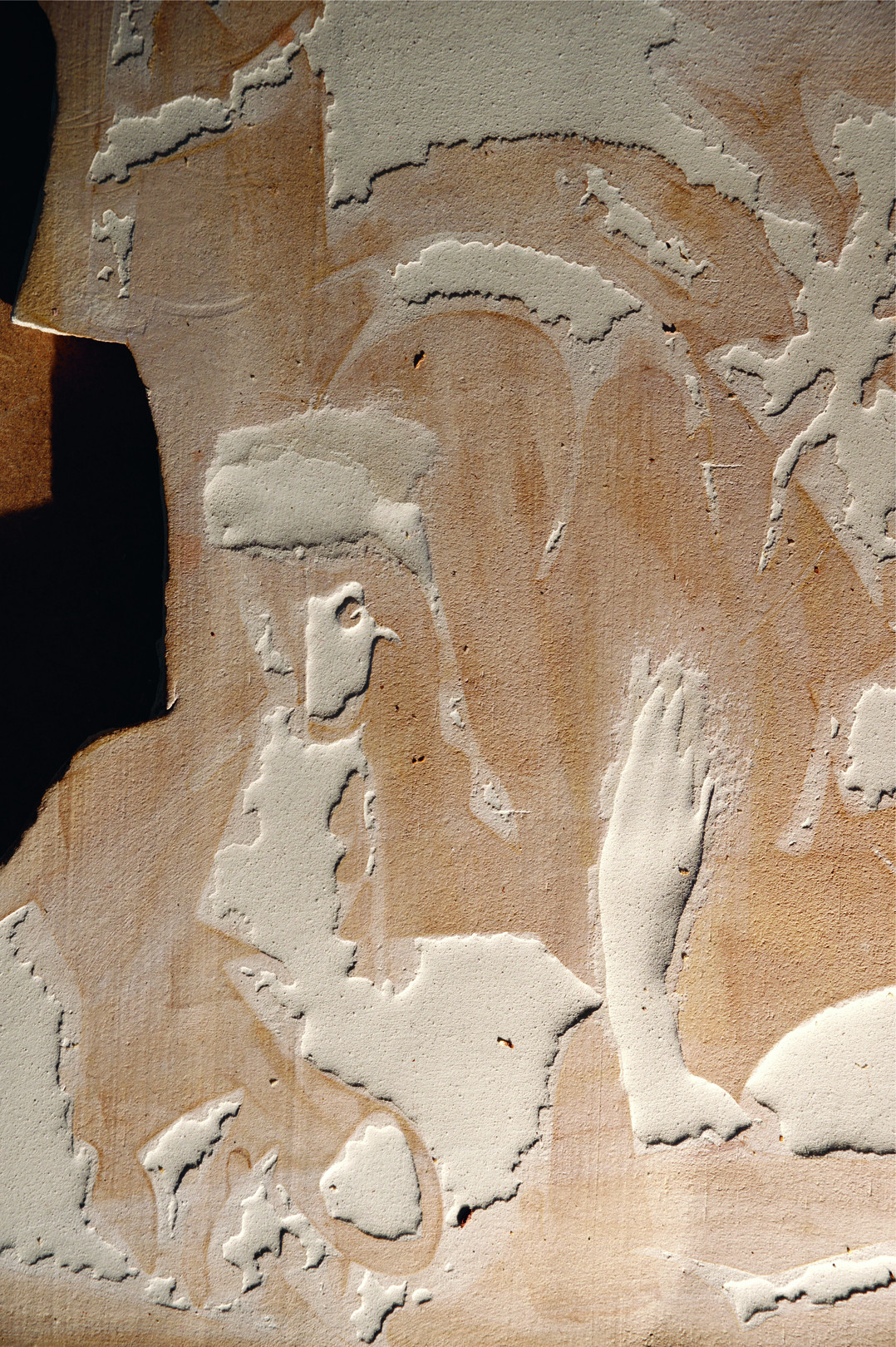
Loading 1, 2022, keramická dlaždice / reliéf, 30 × 30 cm -
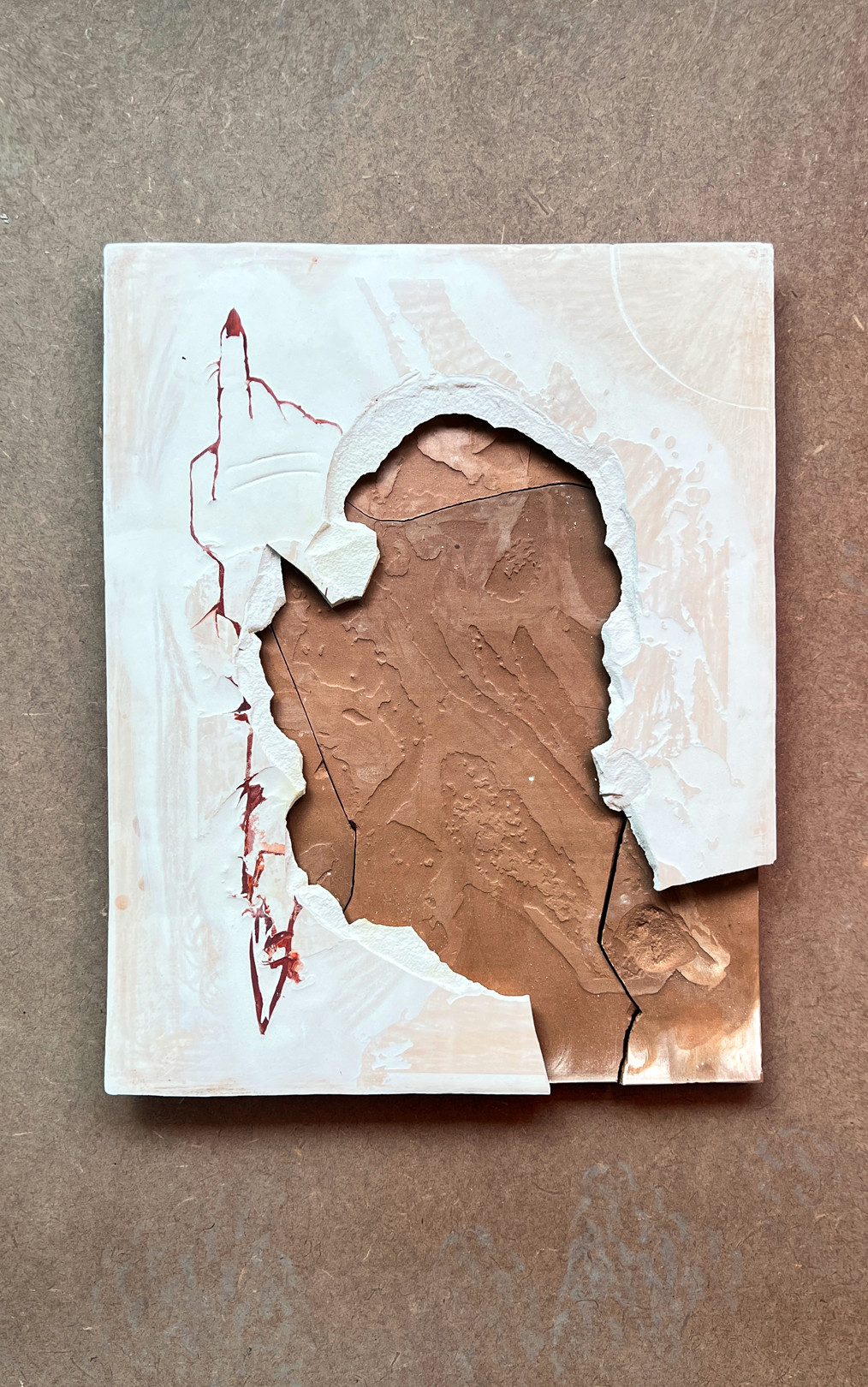
Loading 3, 2022, keramická dlaždice / reliéf, 60 × 50 cm


MgA.
Stanislav ZÁBRODSKÝ
2022
Studies
| 2016–2022 | Intermedia 3, AVU |
| 2020 | studijní pobyt na Institut Seni Indonesia, Yogyakarta, Indonésie |
| 2022 | Defense of MgA., AVU |
- Main topic
- Fourth Moment in Eternia
- Annotation
Diploma works always pass through various layers of association, whether distant or directly related. One of the initial ideas that I work with is the shift in time - I am interested in how a mass, an assemblage of minerals, clays and other parts of soil matter, can bridge the ages under synthetically set conditions (firing) and become a rock that geological time would process for ages. A wide range of chemical reactions and phase transitions take place throughout the exposure to heat: the clay object inside the kiln ages far faster than geological nature suggests. The growth of newly formed crystals, compaction and fusion of the material. Anomalies in temporality. And it is this vast time frame that leads me to archaeology of objects. I am interested in the moment of finding an object subjected to extreme conditions and looking back at what it has become. The imagination of the temporal transformation of the now created object returns me at one point to an unknown moment of primordiality and vice versa – to a desolate landscape, the crumbling relics of what surrounds us. A double movement backwards and forwards. I do not know if the clay slab has aged and returned to the clay deposits, to layers where mining has not yet begun. Or it has aged, stayed in a corner of the room, fallen in with the plasterboard wall, and waits under conditions we do not yet know.
This idea is materialized by my ceramic tiles, and the motif that appears on them speaks to another interest of mine: the various forms of mineral collecting, rock collecting, mineralogy, and the stone collecting community have offered me an interesting perspective on how to grasp the raw materials I use in my work, for example, in developing glaze recipes. In short, through the different phases of my interest in collecting (synthetic semi-precious stone production, technological processing of silicon semiconductors), I began to obsessively view everything through the lens of collecting. From kidney stones, where the physiology of the individual determines the composition of the stone, to the shells of clams metabolizing selected minerals, to shell formation.
These two thematic areas are intertwined. As a result, they touch each other in their material shell, and by the time mineral collecting has become an obsession, even ceramic material is transformed into an article, a cluster of minerals with a unique composition and a remarkable set of qualities.
The ideal attention to my installation is to deconstruct these associations. Identifying what the relief on the tile represents is difficult. Is it a painting, a CT cross-section of a kidney, or just a site map. Unravelling the motif on the ceramic reliefs, tracing and connecting the vague contours, in a way meets the approach of the archaeologist. Everything takes place only in the supposed plane of the methods of archaeology.
- Studio
- Intermedia 3
- Supervisor
- VANĚK Tomáš, prof. MgA.
- Oponent
- BALADRÁN Zbyněk, Mgr.
- Consultant from the university
- BUDDEUS Ondřej, Mgr. Ph.D.
- Thesis status
- Thesis finished and defended successfully
- Date of defence
- 13. 6. 2022
Files
- pdf Thesis Diplom2022_Zabrodsky.Stanislav_INT3.pdf (192.7 KB)
- pdf Review by thesis supervisor Hodnocení diplomové práce Stanislav Zábrodského_T. Vaněk 2022.pdf (190 KB)
- docx Review by thesis reviewer posudek Stanislav Zábrodský.docx (119.54 KB)
- jpg Thesis appendix Priloha2_Stanislav.Zabrodsky_INT3.jpg (4.48 MB)
- jpg Thesis appendix Priloha_Stanislav.Zabrodsky_INT3.jpg (6.23 MB)
- jpg Thesis appendix Priloha3_Stanislav.Zabrodsky_INT3.jpg (3.82 MB)
- jpg Thesis appendix Priloha4_Stanislav.Zabrodsky_INT3.jpg (5.64 MB)
- jpg Thesis appendix Priloha5_Stanislav.Zabrodsky_INT3.jpg (16.65 MB)